Overview
An AI website helper is a chat tool that answers shopper questions from your own pages and product list. Small businesses use them to handle common support questions, product queries and checkout help. We explain how such a helper works in practice, using three illustrative setups for different kinds of business, and how to check and fix its answers. This is a practical guide to how it performs in real use.
An AI assistant on a small business website reads your content and answers questions in plain language. It can answer the same questions many times without tiring. The examples below show what changes between business types, what the assistant reads, and what to do when it gets something wrong. These are setup examples to illustrate the process, not case studies of live websites.
What does an AI assistant do for a small business website?
An AI helper answers common shopper questions and finds products in your live list. It can answer these questions and handle product queries. Shoppers can also ask in the language they prefer.
Automating customer queries and sales support
Most small shops face the same few questions every day. These often cover opening hours, delivery areas, sizes, and returns. An assistant can take these directly. It can search the catalogue by name, need, or budget, display two or three products side by side, and add an item to the cart. Coupons may be applied or removed inside the chat.
Handling diverse languages and patchy connections
Shoppers in India often use more than one language, so the helper answers in English and nine Indian languages, such as Tamil, Hindi, Telugu, Kannada, and Bengali. It replies in the script the shopper uses. A chat stays in place when a shopper opens a new page or tab, which helps on patchy mobile connections.
Keeping the site light
A lightweight widget can help you avoid adding unnecessary page weight. Our assistant loads after your page does. The chat panel is fetched only when a shopper opens it. The launcher fits neatly into your layout.
Three small businesses using an AI assistant
The same tool works in different ways based on what the business sells, where its answers come from and which questions matter most. We show how the setup can change with each case.
Example 1: A small cafe
A café wants fewer phone calls about its menu, allergens and opening hours. The owner pastes the homepage URL, so the assistant can read the menu page and the about page, then connects WooCommerce so prices and availability come from the live store. The main content sources are the menu page and any allergen notes.
Sample shopper question: “Does the oat milk latte contain nuts?” Sample assistant reply: “The allergen note on the menu page lists nuts as a possible cross-contact risk for the oat milk latte. Please check with staff if you have a severe allergy.”
Sample shopper question: “Is the weekend special still on?”
Sample helper reply: “The current weekend special and its price are shown in the live menu. It reflects what is available now.”
The safeguard that matters most here is the allergen wording. The owner tests the allergen questions first, reads the passages behind each reply, and rewrites any menu line that produces a vague answer.
Example 2: A clothing boutique with a size-heavy catalogue
A boutique sells clothing in many sizes and cuts. Shoppers ask if a dress runs small, which size suits a given height, and if an item can be returned after a sale. The main content sources are the product pages, a size chart, and a returns policy.
Sample shopper question: “Does this dress run small?” Sample assistant reply: “Based on the product page and size chart, it fits true to size. Sizes are listed in the chart for each measurement.”
Sample shopper question: “Can I return a sale item?”
Sample helper reply: “The returns rules cover sale items as described in the document. Please check the stated return period before you buy.”
Here the size chart is the key source. The owner uploads it as a CSV or spreadsheet rather than an image, because the assistant can read the numbers in a table but not reliably read them from a picture. Live stock matters too, since recommending a size that has sold out creates a disappointed shopper.
The safeguard is checking that sizing answers match the chart. The owner tests questions about fit and compares each reply with the source table before going live.
Example 3: A stationery shop with a multilingual shopper base
A small stationery shop sells school supplies to families who ask in Hindi, Marathi, and English, often mixing languages in one message. Shoppers want to know what a set includes, if an item is in stock, and how to pay with a coupon. The main content sources are the product catalogue and the delivery guide.
Sample shopper question in Marathi asks what a school set contains. Sample assistant reply in Marathi lists the items in the set from the product catalogue, using the same script the shopper used.
Sample shopper question in English: “Is this set in stock?” A sample helper reply is: “Stock is read live from the product list, so the reply matches what is on hand now.”
The assistant replies in the language and script each shopper uses. Because a family may leave the chat and return later, the conversation remains in place across pages.
The safeguard is checking the multilingual answers. The owner asks the same question in each language the shop serves and confirms the replies agree on price and stock.
How does an AI assistant use your website content?
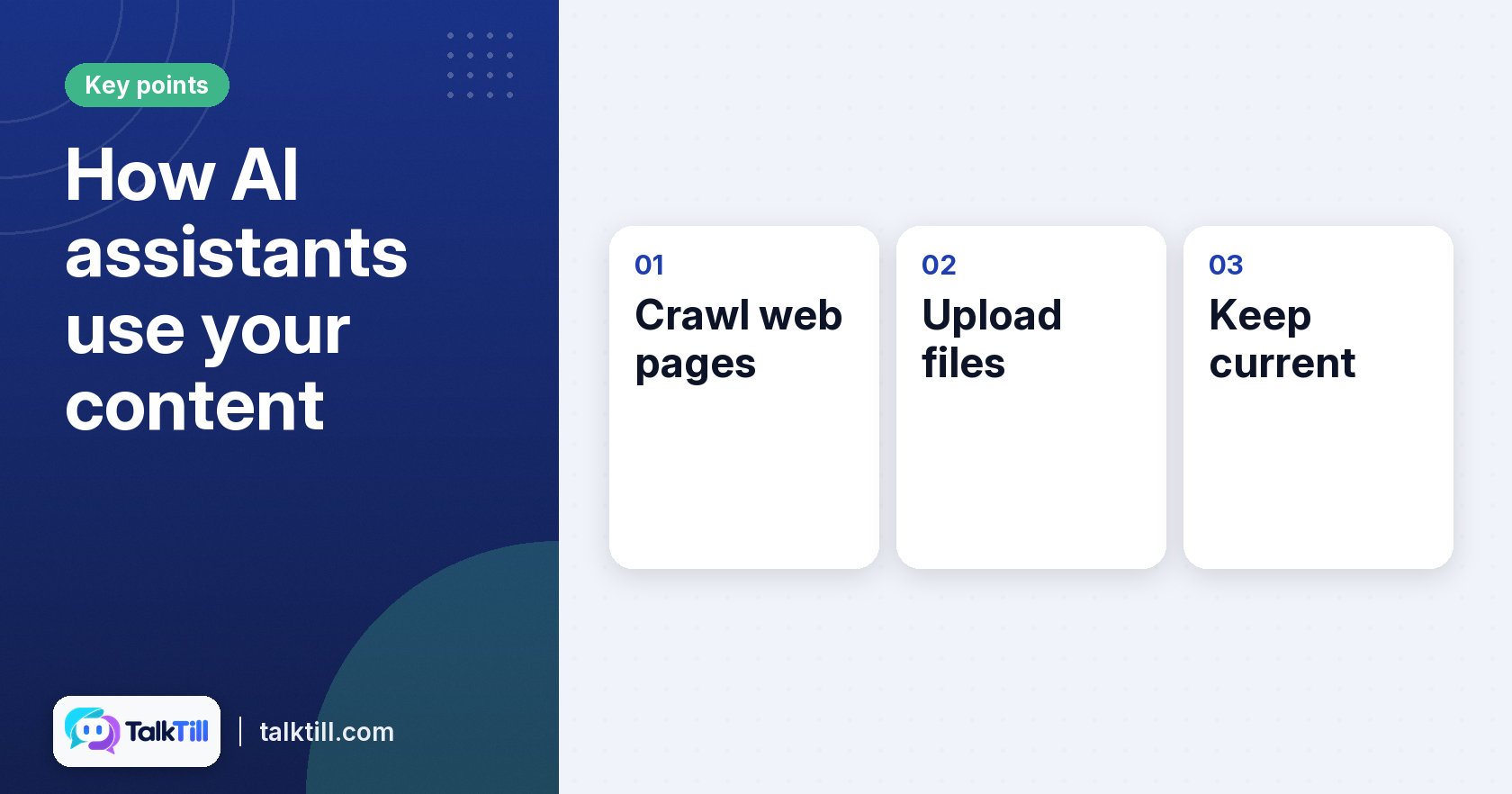
An AI assistant uses the pages you publish, your product catalogue and any files you upload. It reads them the way a person skims a page. It finds the passage most likely to answer a question and builds its reply from that passage.
Crawling website pages and product catalogues
The assistant reads your public pages and reports every page it reads. A product catalogue syncs on its own, so new items appear without manual work. Price and stock are read live, so the assistant will not quote an old figure.
Uploading additional knowledge files
You can upload PDF, text, Markdown, HTML, CSV and Excel files. A size chart is more useful as a real table than as an image, because the assistant can read the numbers. Upload a returns policy or delivery guide too, so the assistant has the detail your pages leave out.
Keeping content current
You set how often sources are read again. Each source shows when it was last read and how many passages it holds. Pages that answer one question each, with that question in the heading, are read most reliably. Outdated content can cause wrong answers, so review your pages on a schedule.
What happens when an AI assistant gets an answer wrong?

When an answer is wrong, a good system shows you the passages it considered and why it chose them. That lets you find the cause and fix it. Without that record, you can only guess.
Understanding the trace behind every answer
Our trace feature records every candidate passage the assistant considered for an answer. It also logs the relevance score of each one and which passages it used or rejected. Each answer is marked as grounded or ungrounded, meaning any of your content may have been used.
Diagnosing the root cause of incorrect replies
A wrong recommendation can have three causes, and each needs a different fix. If the right content was never retrieved, the information may be missing or unindexed. The threshold needs tuning if the right content was retrieved but scored below the cut-off. If the right content was used and the reply is still wrong, the wording is the problem.
Improving content and assistant performance
Once you know the cause, the fix is usually small. Add the missing detail to a page, rewrite a heading to match how shoppers ask, or adjust the threshold. Check the ungrounded answers regularly, because they show exactly what your content does not cover.
General lessons from using AI website examples
The three examples share a pattern. An assistant works well when its answers can be checked, its content is clear and current, and its data is live across every business type. Each business needs to test the questions its own shoppers ask most.
Prioritizing transparency and explainability
Choose a tool that shows you the passages behind each answer. Without that, you cannot tell if a fault lies in your content, the settings, or the wording. Transparency turns a vague complaint into a specific fix.
The role of well-structured and current content
Many wrong answers begin with content that is missing, out-of-date or hard to read. Write one clear answer per page, state key facts such as return periods in the first sentence, and review pages on a schedule. The assistant can only be as accurate as the content it reads.
Choosing an AI solution that fits your business needs
Check if the assistant reads live prices and stock, supports the languages your shoppers use, and keeps your page fast. Ask how it records its reasoning. A small shop gains more from a tool it can inspect and correct than from one that promises perfect answers.
Key takeaways
- An AI assistant answers shopper questions from your pages, files and live catalogue.
- The main content sources differ by business, such as menus, size charts or product catalogues.
- Live price and stock data help the assistant avoid quoting out-of-date information.
- The trace shows which passages were used and which were rejected, so you can diagnose wrong answers.
- Clear, current content is the main factor in accurate replies.
Conclusion
An AI website assistant can answer common questions and handle product enquiries to help shoppers find what they need. The three examples show that content sources, shopper questions, and safeguards change with the business. Its value depends on content you can check and fix, which is why transparency matters as much as speed. Our AI sales assistant page describes how the tool handles product actions.
FAQs
How do AI assistants handle sensitive customer data?
Keep sensitive details out of public pages and uploaded files. Limit what the assistant can read. Review the data retention settings for conversations before you go live, and check the vendor’s policy in writing.
Can an AI assistant integrate with my existing CRM system?
It depends on the platform. Ask the vendor which systems it connects to and how. A store that uses WooCommerce can connect live product data directly.
What are the typical costs associated with an AI website assistant?
Costs vary with the vendor and the number of conversations. Compare the monthly price, the number of replies included and any charges for extra features. Read the current pricing page before you decide.
How long does it take to set up an AI assistant on a website?
Setup time depends on the platform, the integrations you need and how ready your content is. Testing and rewriting unclear content often takes longer than the initial connection. Plan time for reviewing answers before customers see them.
Can AI assistants generate images or videos?
A customer support assistant of this kind answers in text and does not generate images, audio or video. If you need media generation, you need a different tool.
What kind of support is available if I encounter issues with my AI assistant?
Ask the vendor what support it offers and how quickly it responds. Check if a person can take over a conversation when the helper cannot answer. A good vendor will explain how to diagnose a wrong answer, not just reset the tool.