
Overview
Improving an ecommerce conversion rate means getting more visitors to complete a purchase. Many common beliefs about this goal are wrong. This article looks at six myths, from trusting vendor resolution rates to assuming complex AI is needed. It shows why visibility into how an AI assistant reaches its answers helps you find and fix the real blockers.
A conversion rate is the share of visitors who buy. It is a simple number with many possible causes. When it falls, the fix depends on finding the cause, and that is hard when the tools you use hide their working.
It is easy to add an AI assistant. You get answers and product recommendations. If you spend time or money on a change, the six myths below are worth checking before you proceed with your plan, considering time, money, and potential outcomes.
Myth: A high resolution rate means your AI is boosting sales
A high resolution rate is not a reliable sign of sales performance. The term has no shared definition, and it does not measure completed orders.
Why resolution rates are misleading
Both figures can appear on a sales page, yet they describe different things.
A figure measured over a vendor’s best customers, in one language, on simple questions, will often beat a figure measured across every customer. That does not make either number false. It makes them incomparable. Treat any single resolution rate as a claim to investigate, not a result to compare.
What truly indicates a successful customer interaction
It is simple. You follow the chat to the cart and then to a completed order. If you cannot yet measure that path, read a sample of conversations yourself. This will help you find questions the assistant answered well, questions it got wrong, and moments where the shopper simply left, which can be about the product or the price.
Myth: You can improve ecommerce conversion rate without seeing how your AI works
Improving conversion with AI needs visibility into the steps between a question and an answer. Seeing only the input and the output is not enough to diagnose a fault.
The problem with hidden AI processes
Imagine a shopper is quoted the wrong price. There are two very different causes. Either the right page was never found, or it was found and misread. Both produce the same wrong answer, but they need different fixes.
Many AI chat platforms show only the question and the reply. Everything that decided the answer stays hidden. You are left guessing, and guessing wastes time on the wrong fix.
How a retrieval trace reveals the ‘why’ behind answers
A retrieval trace shows the working. It lists each passage the assistant considered, the score it received, and the reason any passage was dropped. An audit log only records that an answer was given. A trace tells you why it was wrong.
This is how Talktill builds its assistant. You can check each stage. If a wrong product appears, you can see if the correct passage was missing or ranked too low. That turns a vague problem into a specific one you can act on, and it helps you to improve the assistant’s performance over time.
Myth: Shoppers will find what they need if your product pages are clear

Clear product pages help, but many shoppers still need a direct answer. An AI sales assistant can answer that question at the moment it is asked, before the shopper leaves for another site.
Beyond product pages: The need for active assistance
A shopper may ask if a jacket comes in a size that suits a narrow frame, or if a kitchen tool fits a particular budget.
When a tool can settle the question, the assistant should use it. For example, it can check livestock before suggesting an item, rather than offering something that has already sold out.
How AI sales assistants guide shoppers to purchase
TalkTill’s assistant can search the live catalogue by name, need, or budget. It shows product details and side-by-side comparisons, and it presents colours and sizes as choices on the product card. A shopper can add items to the cart and view it without leaving the chat.
Test this yourself. Ask the assistant the five questions your customers ask most often. If any answer sends the shopper elsewhere, the sale is at risk.
Myth: Complex AI platforms are necessary to improve ecommerce conversion rate
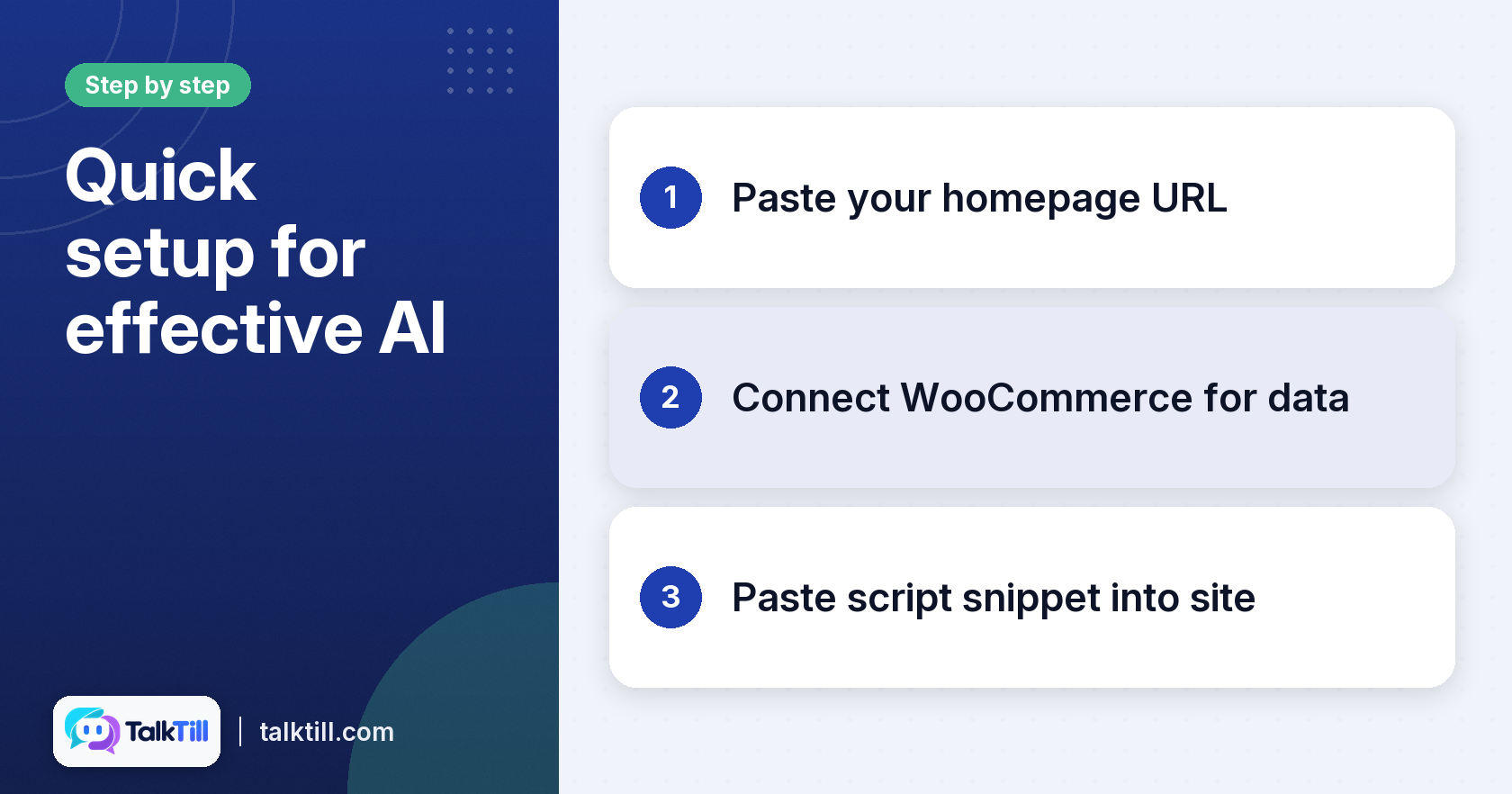
Effective AI for ecommerce can be set up quickly and simply. The essentials are live data for price and stock, and support for the languages your shoppers use. You do not need a long project to start.
The simplicity of effective AI implementation
TalkTill’s setup has three steps. Paste your homepage URL, so the assistant can learn your content. Connect WooCommerce for live price and stock. Then paste a short script snippet into your site.
It loads after your page. You get a small script. The chat panel is 37.97 KB and loads only once a shopper opens it. If you use our method, this often takes about fifteen minutes to a working assistant on your own site, without a professional-services engagement.
Key features for a quick and impactful setup
Before you choose a tool, check three things. Does it read live price and stock? Does it show where each answer came from? Can you test it with real questions before shoppers see it?
A simple rule helps here. If a tool needs a long engagement before you can test a single answer, expect slow fixes later too.
Myth: All AI assistants handle multiple languages and patchy connections equally well
Not all AI assistants suit every market. If your shoppers use several languages or browse on slow mobile connections, check those needs before you choose.
The unique challenges of diverse markets
Many stores serve shoppers who switch between languages, or who use phones with unreliable data.
TalkTill was built for Indian shoppers, with support for English and nine Indian languages. Its script is small so it loads on patchy connections.
Designing AI for accessibility and accuracy
Accuracy depends on reading current data. A recommendation for an item that sold out this morning is worse than no recommendation at all. TalkTill’s assistant reads live stock and prices rather than a snapshot taken earlier.
Test your own language and connection needs. Ask the assistant a question in each language your shoppers use, and check that the stock and price it quotes match your store.
Key takeaways
- A high resolution rate does not reliably show sales performance, because the definition varies.
- Visibility into each stage of an AI answer helps you tell a missing document from a misread one.
- Shoppers often need a direct answer, not just a clear product page.
- Effective AI can be set up quickly, with live price and stock data and a small script.
- Test language support and load size against how your shoppers actually browse.
Conclusion
Improving ecommerce conversion rate depends on finding the real blockers. Be wary of vanity metrics, and look for tools that show their working. Start with live data, test real questions, and read the conversations yourself. If you want to see how the steps behind an answer appear, you can try TalkTill’s assistant on your own store.
FAQs
What is a good conversion rate for ecommerce?
A good rate depends on your sector, traffic source and price point, so there is no single target. Compare your rate with your own past figures first. Track the same measure over time before you judge a change.
How can I track my ecommerce conversion rate?
Divide completed orders by the number of visitors in the same period. Set the period and the visitor count the same way each time. Many analytics tools can report this directly once purchases are tagged.
What are common reasons for low ecommerce conversion rates?
Common causes include slow pages, unclear shipping costs, and questions that go unanswered before checkout. Stock and price errors also drive shoppers away.
Can website design impact conversion rates?
Yes. Clear navigation, readable product images and a simple checkout can reduce the steps a shopper must take. Test one change at a time so you can see which change made the difference.
How do customer reviews affect ecommerce conversion?
Reviews can reassure shoppers who are unsure about fit, quality or value. Read reviews yourself for recurring questions, and answer those questions on the product page or in the assistant.
What role does pricing play in ecommerce conversion?
Price is one factor among several, alongside trust, delivery and product fit. Show prices clearly and keep them current. An assistant that quotes an outdated price can cost you a sale and trust.